
All solutions

Weather monitoring

Know when to spray, sow or irrigate: your farm's 7-day forecast, and alerts for frost, heat or heavy rain.

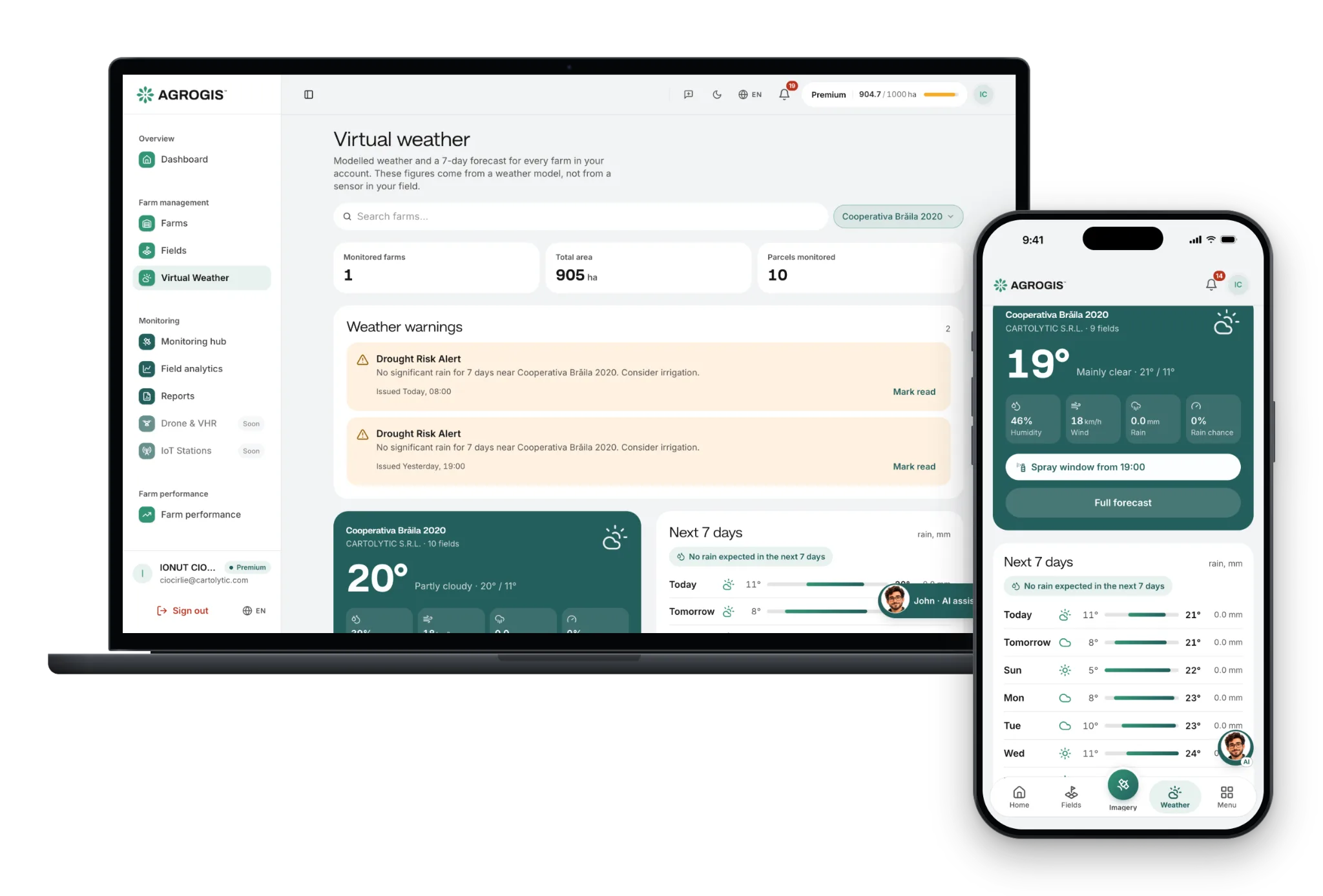
Every farm gets a virtual weather station at its own coordinates, with nothing to install: an hour-by-hour forecast for 24 hours, 7 days ahead, spraying windows, and alerts checked morning and evening. On Premium and Enterprise, or with the weather module on Basic.

7 days
forecast for your farm, hour by hour for the first 24 h
2× a day
alerts checked morning and evening
No hardware
a virtual station at the farm's coordinates
Coming soon
connect your own weather station
One year of weather on one farm

What the alerts would have told this farm in 2025

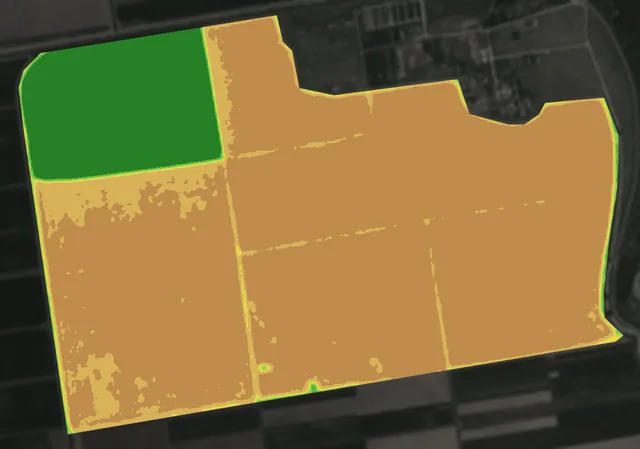
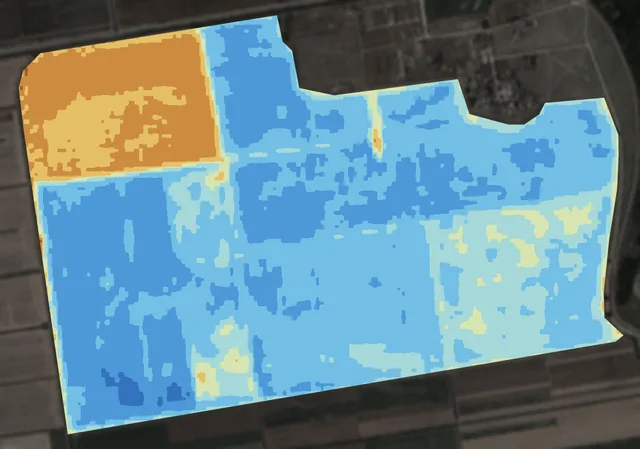
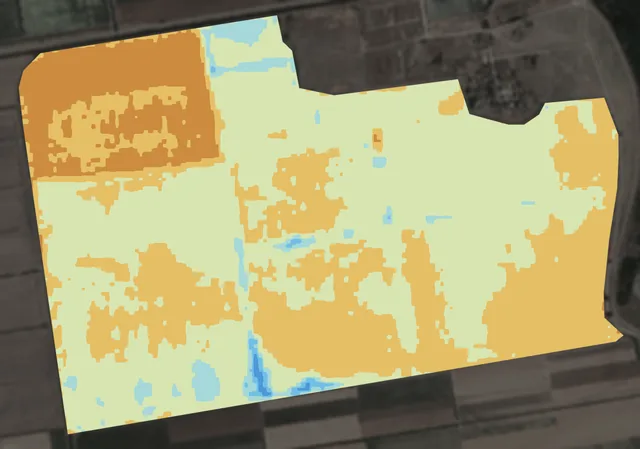
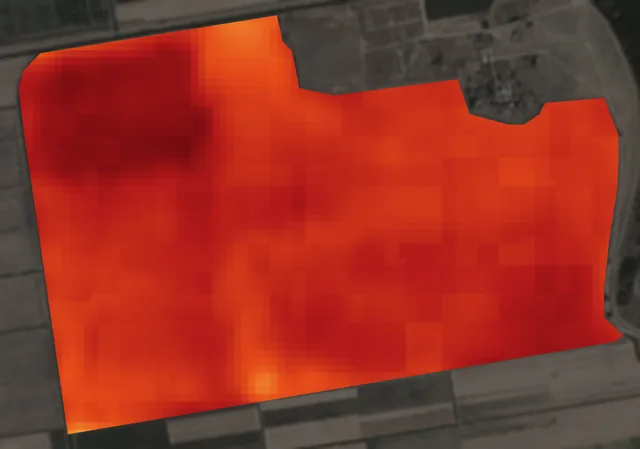
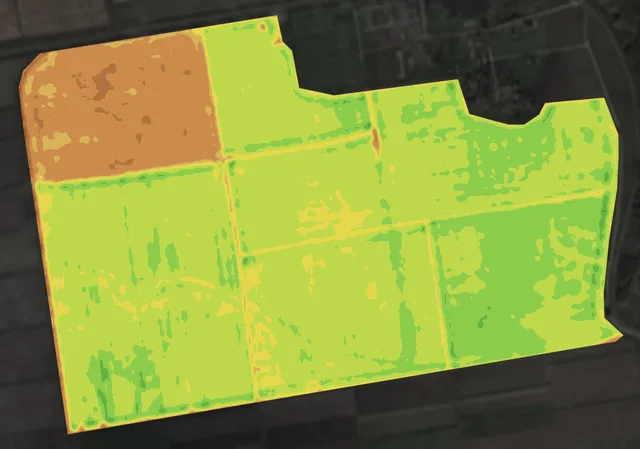
The same 320 hectares in the Bărăgan plain as on the satellite page: the year’s real weather on the farm, the alerts the app’s rules would have sent, and what the fields did. Scroll: the map and the chart follow each step.

  1. 1

    A frost in April, with the winter crop already growing

    From 7 to 11 April the nights went down to between −1.1 and 1.1 °C. The frost alert (3 °C or lower in the next two days) would have gone out on each of those days.

    Field A, the winter crop, was already green. The spring fields, B to F, were not up yet: they came up from late May.

    What you do: Check the winter crop after the cold nights, and plan the spring sowing around the cold spell.

    rain a day (30 mm and more drawn at the top)highest temperature, 0–40 °Ca day the alert would have gone out
    bare soildense crop
  2. 2

    A month without rain, and the drought alert every day

    From 29 May to 27 June no day brought more than 2 mm of rain. June had 4 mm in all, while the weather could have evaporated 179 mm.

    The drought alert (7 days without significant rain, and none forecast) would have gone out every day from 5 to 26 June. By 3 July, fields E and F were short of water.

    What you do: See the dry spell coming and plan irrigation and field work around it, before it shows on the crop.

    rain a day (30 mm and more drawn at the top)highest temperature, 0–40 °Ca day the alert would have gone out
    severe stressenough water
  3. 3

    Heat and very dry air in July

    Eleven days went above 35 °C, eight of them in July; the hottest reached 37.9 °C, on 26 July. On 14 July the fields’ surface was between 49 and 54 °C.

    That stayed under the heat alert’s 38 °C. But the air was so dry that the dry-air alert (evaporation stress) would have gone out on 64 days between 18 June and 9 September.

    What you do: Spray in the cooler hours the spray window points to, and expect the crop to use water faster.

    rain a day (30 mm and more drawn at the top)highest temperature, 0–40 °Ca day the alert would have gone out
    40 °C56 °C
  4. 4

    After a dry summer, 73 mm in a day

    From 30 July to 10 September, 43 days in a row brought no more than 2 mm of rain a day. Then 73 mm fell in 24 hours on 7–8 October, and the heavy-rain alert (30 mm) would have gone out on both days.

    October brought 133 mm in all. On 5 November the new crop was up evenly on fields B to F.

    What you do: Check drainage and field access before the rain, and afterwards check on the map that the crop came up.

    rain a day (30 mm and more drawn at the top)highest temperature, 0–40 °Ca day the alert would have gone out
    not up yetstrong emergence

Weather: ERA5 reanalysis at the farm’s coordinates (Open-Meteo historical archive). Alerts: the app’s own rules and default thresholds applied to what happened; in the app they run on the forecast, a day or two ahead. Maps from 2025 Sentinel-2 and Landsat 9 images. Contains modified Copernicus Sentinel data 2025. Landsat: USGS.

Where the weather comes from

Your farm's weather, from a virtual station — and soon from your own

Today every farm gets a virtual station at its own coordinates, with nothing to install. Connecting a physical station — yours, or one we fit for you — is on the way.

  • The virtual weather station

    Available

    Global weather models, calculated for the farm's coordinates. On Premium and Enterprise, or with the weather module on Basic.

  • Your weather station

    Coming soon

    Connect the station you already have, so the data comes from your own field.

  • An AGROGIS station

    Coming soon

    A station we install on your farm, connected from day one.

Your farm in AGROGIS

The weather sits beside your parcels, jobs and satellite images.

  • 7-day forecast

    Hour by hour for the next 24 hours: temperature, rain, wind, humidity.

  • Alerts in the app

    Frost, heat, heavy rain, strong wind and drought — checked morning and evening.

  • Spraying windows

    Spraying conditions hour by hour, so you pick the right moment.

Want to connect the station you already have?

Tell me when

What you get

Everything you need to make field decisions based on data — not assumptions. Features included in this solution:

  • / 01

    A virtual weather station for every farm — set the location, install nothing (Premium, Enterprise, or the weather module on Basic)

  • / 02

    Hour-by-hour forecast for 24 h and 7 days ahead: temperature, rain, wind, humidity

  • / 03

    Know how warm and how moist the soil is before you choose a sowing day

  • / 04

    Alerts for frost, heat, heavy rain, strong wind and drought

  • / 05

    Spraying conditions hour by hour, and soil water for irrigation decisions

  • / 06

    Connecting your own weather station — coming soon

How it works

How it works, step by step, from the first message to the result.

  1. 1

    Set your farm's location

    The virtual station switches on for the farm's coordinates — nothing to install, nothing to configure.

  2. 2

    See the forecast

    Current conditions, an hourly 24 h forecast and a daily 7-day outlook — one card per farm on the Weather page.

  3. 3

    Get alerts

    AGROGIS evaluates every farm's forecast in the morning and in the evening and notifies you in the app about frost, heat, heavy rain, strong wind or drought.

  4. 4

    Plan the work

    Choose spray, sowing and irrigation windows based on your farm's forecast, not the nearest town's.

Technical details

For anyone who wants the exact numbers: sources, frequency, formats. For anything else, write to us.

Data source
Global weather models, computed per farm
Coverage
Every farm with a location, on Premium or with the weather add-on on Basic; no equipment needed
Forecast
Hourly for 24 h + daily for 7 days
Parameters
Temperature, rainfall, wind, humidity, soil temperature and moisture, ET0
Alerts
Frost, severe frost, heat, heavy rain, strong wind, drought
Alert runs
Twice a day — morning and evening

Frequently asked

  • Do I need a physical weather station?
    No. The virtual station uses the global weather models computed for your farm's coordinates and switches on for every farm with a location, on Premium or with the weather add-on on Basic. Integration of your own weather station is in the works.
  • How accurate is the forecast?
    The data comes from global weather models — the most widely used in the world — at the model grid's resolution. For very specific microclimates (valleys, slopes) your own station remains the reference; that is why we are working on integrating it.
  • Which alerts do I get, and how?
    Frost risk, severe frost, heat, heavy rain, strong wind and drought stress. AGROGIS evaluates every farm's forecast in the morning and in the evening and sends in-app notifications, without repeating the same alert on every run.
  • Can I connect the weather station I already own?
    Not yet — integration of your own weather station is coming soon. Until then, the virtual station covers every farm on Premium or with the weather add-on. Write to us if you want to be notified when it becomes available.

Ready to start?

Try it on your own parcels, or tell us what you need — we reply within one business day.